USDC's Legal Path in Japan: What the June 2026 Stablecoin Rules Mean for Payments
By Compliance Team · July 7, 2026 · 7 min read

For years, using a dollar stablecoin to pay in Japan sat in a grey zone. The first opening came in March 2025, when SBI VC Trade registered to handle USDC; the general rule followed in June 2026. Under an amended Cabinet Office Ordinance under the Payment Services Act, effective 1 June 2026, qualifying foreign stablecoins can now be distributed in Japan through licensed intermediaries, regulated by the Financial Services Agency (JFSA) as Electronic Payment Instruments (EPI). For a business deciding whether to accept USDC, that is the legal clarity that was missing.
What actually changed
Japan's framework treats fiat-backed stablecoins as Electronic Payment Instruments, and a foreign stablecoin can only be offered through a registered Electronic Payment Instrument Exchange Service Provider (EPIESP) after clearing a JFSA "equivalence" test on its issuer and reserves. The practical result is a short, curated list of stablecoins that are actually usable on licensed platforms.
| Stablecoin | Status in Japan | Pathway |
|---|---|---|
| USDC | Usable via licensed distribution | SBI VC Trade (registered EPIESP) + Circle |
| RLUSD | First foreign stablecoin to clear JFSA equivalence | SBI VC Trade / Ripple, June 2026 |
| JPYC | Legal domestic yen stablecoin | JPYC Inc. (licensed issuer) |
| USDT | Not available on licensed platforms | No registered distributor |
Two nuances the headlines flatten. First, USDC's route to market is its distribution partnership with SBI VC Trade, which registered as an EPIESP — the token is usable, but through that regulated channel rather than freely. Second, Ripple's RLUSD was the first foreign-issued stablecoin to formally clear the JFSA equivalence test under the new rules, launching on 25 June 2026, also via SBI; USDC had been available through SBI VC Trade since March 2025 under the earlier registration. USDT, by contrast, has no licensed distributor and remains effectively unavailable on regulated Japanese platforms.
Why it matters for hotels and merchants
Japan drew over 40 million inbound visitors in 2025, a growing share of whom carry stablecoins. A hotel, ryokan or merchant that accepts USDC through a compliant pathway can serve that demand while cutting processing from the 3–4% typical of Japanese cards (plus FX on foreign cards) to a flat 0.5%, settled in about a second with no chargebacks. Retail precedent already exists — major electronics chains have accepted crypto for years — so acceptance is not the leap it once was.
- Legal clarity: USDC is a recognised Electronic Payment Instrument, not a grey-area asset.
- Lower cost: 0.5% versus 3–4% card-plus-FX on inbound guests.
- Finality: on-chain settlement removes chargebacks on high-value ryokan and hotel stays.
- Omotenashi: one less point of friction at checkout, complementing service rather than replacing it.
Furlpay's honest status in Japan
Furlpay is a payments platform, not a stablecoin issuer or a JFSA-registered exchange. We are not registered with the JFSA as a Crypto-Asset Exchange Service Provider or an EPIESP, and we do not claim to be — those registrations require a local presence and are how distribution is licensed in Japan. We are evaluating a licensed-intermediary pathway and state exactly where we stand on our Japan trust page. See how acceptance works for Japanese hotels.
Furlpay is not a bank and is not registered with the JFSA. Crypto assets are high risk, are not legal tender, and can lose value. Regulatory details are accurate to the best of our knowledge as of July 2026 and continue to develop; consult qualified Japanese counsel about your specific situation. This article is information, not legal advice.
Furlpay
Written by the Furlpay team — engineers and compliance specialists building an on-chain financial operating system for stablecoin payments, travel, and investing on Arbitrum.
Don't miss the next one
Stay ahead of the curve
Get product updates, engineering deep-dives, and security bulletins. No spam — just the signal.
More in Legal & Compliance
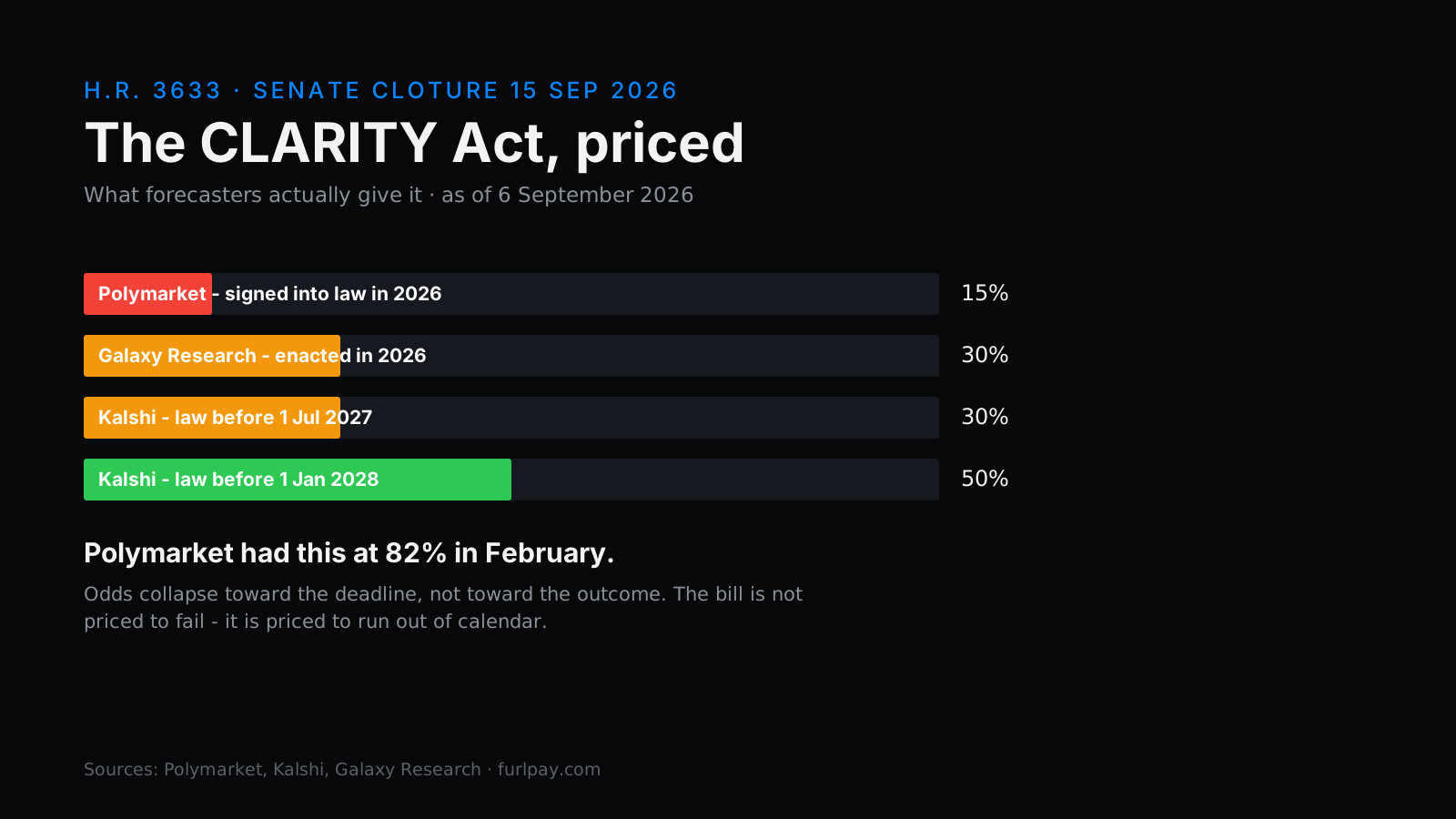
The CLARITY Act Is Not Dead. It Is Running Out of Calendar.
Updated 12 October: the 15 September cloture vote failed 49–50. Before it, prediction markets gave the CLARITY Act a 15% chance of becoming law in 2026 — and 50% by January 2028. The bill is late, not dead. Meanwhile JPMorgan settles more than $7bn a day in tokenized deposits without waiting for it. What the 15 September Senate vote decided, what atomic settlement does and does not fix, and why the strongest objections come from the people who understand market structure best.
September 7, 2026 · 23 min read
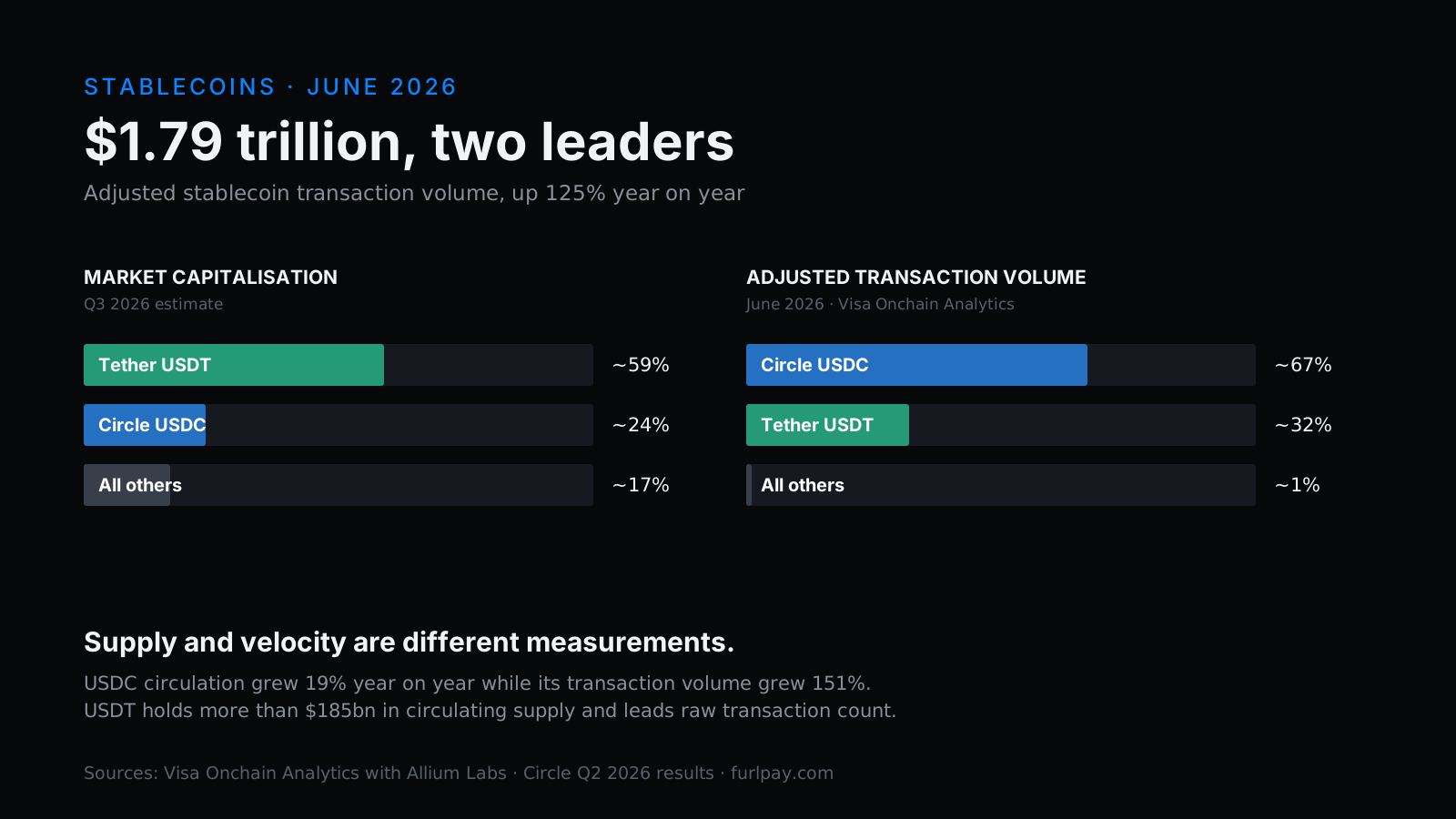
Stablecoin Transaction Volume in 2026: Circle, Tether and the Race to Build the Payment Rail
Stablecoins settled $1.79 trillion in adjusted transaction volume in June 2026, up 125% year on year. USDC accounted for approximately 67% of that volume; USDT remains the largest stablecoin by market capitalisation at more than $185 billion. An analysis of what each metric measures, where Circle and Tether actually stand, and what Visa, Mastercard, Stripe, PayPal and Coinbase are building around them.
September 7, 2026 · 15 min read

Stablecoins Quietly Overtook Crypto for Cross-Border Payments — Here Is the Data
In 2025 stablecoins settled about $33 trillion on-chain, more than Visa and Mastercard combined, while Bitcoin and Ethereum's share of cross-border flows kept shrinking. The GENIUS Act, Stripe's $1.1B Bridge deal and Mastercard's $1.8B BVNK deal all landed in the same window. Here is what actually happened, with the figures checked against primary sources — and where a middleware layer like FurlPay fits.
July 18, 2026 · 12 min read